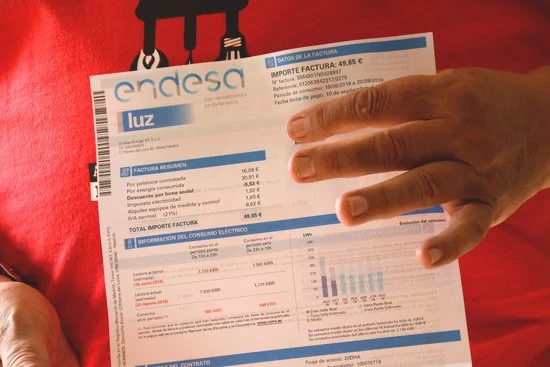
Electricity bills in Tenerife regularly come as a shock to British expats. The system is complex, the bills are in Spanish, and the charges are split across multiple line items that are difficult to make sense of without help. The good news is there are several legitimate ways to reduce what you pay — and in many cases, expats are missing out on discounts they're fully entitled to. This guide walks you through every option.
Understanding Your Spanish Electricity Bill
Before you can reduce your bill, it helps to understand what you're actually paying for. A Spanish electricity bill typically includes several distinct charges:
- Potencia contratada — a fixed daily charge based on the maximum power capacity you have contracted (in kilowatts). You pay this regardless of how much electricity you use.
- Consumo — the actual electricity you use, charged per kilowatt-hour (kWh).
- Impuesto sobre la electricidad — a Spanish electricity tax, currently around 5.1%.
- Alquiler del contador — a small rental charge for the electricity meter.
- IVA — Spanish VAT at 21% applied to the total.
For most households, the potencia charge represents 30–50% of the bill. Many expats are contracted for far more power than they actually need — reducing this is often the single fastest way to lower monthly costs.
The Bono Social: Government Electricity Discount
The Bono Social is a Spanish government scheme designed to protect vulnerable households from high energy costs. It reduces your electricity bill by a percentage set according to your circumstances, and is applied automatically to every bill once approved. If you qualify, this is the most impactful saving available.
Discount levels
- 25% discount — standard vulnerable household
- 40% discount — vulnerable household (higher level)
- 65% discount — severely vulnerable household
In practical terms, this can mean saving €20–€60 per month depending on your usage and tariff.
Who qualifies?
You may be eligible for the Bono Social if you fall into any of the following categories:
- Pensioners whose total household income is below approximately €14,000 per year (or €19,000 for couples) — this includes UK state pension recipients who are resident in Spain
- Large families with three or more children
- Unemployed people receiving benefits, including paro or the over-52s subsidio
- People with a recognised disability of 33% or more
- Victims of gender violence
- People receiving Spain's minimum income benefit (IMV) through Social Services
You must be the named account holder on the electricity contract, and you must be on the regulated tariff (PVPC — Precio Voluntario para el Pequeño Consumidor) rather than a fixed-rate market contract. If you're currently on a market contract, switching back to PVPC first is a necessary step before applying.
How to apply
Applications are made directly to your electricity supplier — not to a government office. The main suppliers in Tenerife are Endesa, Naturgy, and Iberdrola. You'll need to provide:
- Your NIE or TIE card
- Your Padrón certificate (empadronamiento)
- Your electricity contract or CUPS number (found on your bill)
- Proof of qualifying status — pension statement, unemployment documents, disability certificate, or family book (libro de familia) as applicable
- Proof of income — recent bank statements or tax return (declaración de la renta)
Applications can be made by phone, through the supplier's website, or in person at a supplier office. The process involves submitting Spanish-language forms and explaining your circumstances — this is where having an interpreter alongside you makes a significant difference to the outcome.
Reviewing and Reducing Your Potencia Contratada
As mentioned, potencia is the fixed daily charge for your contracted power capacity. Most apartments and small houses in Tenerife run perfectly well on 3.3kW or 4.4kW, but many contracts are set at 5.5kW or higher — often because a previous tenant needed it, or because nobody has ever reviewed it.
To check whether you can reduce your potencia, look at the highest usage on any single bill over the past year. If you've never come close to tripping the circuit breaker and your usage peaks are modest, you can almost certainly reduce. Contact your supplier and request a cambio de potencia. There is a small administrative fee, but the ongoing saving typically pays for it within a month or two.
Changing Electricity Supplier
Spain has a fully open electricity market, meaning you can switch supplier at any time with no exit penalty. The network itself (the physical cables and meter) doesn't change — only the company billing you. Main suppliers active in Tenerife include:
- Endesa — the dominant supplier in the Canary Islands, with local offices
- Naturgy — formerly Gas Natural, strong across Spain
- Iberdrola — major national supplier
- Repsol and Holaluz — competitive online-first suppliers sometimes offering better rates
When comparing offers, focus on the price per kWh for consumption and the daily potencia rate — both figures are needed to make a fair comparison. A supplier with a low consumption rate but a high potencia charge may actually cost you more overall if your base usage is modest.
Switching typically takes 1–3 weeks. Your new supplier handles the process; you don't need to contact the old one.
Time-of-Use Tariffs (Discriminación Horaria)
If you have a smart meter (which most properties in Spain now do), you may be able to take advantage of a time-of-use tariff — known as discriminación horaria or the three-period tariff (punta, llano, valle). Under this system:
- Valle (off-peak) — cheapest electricity: roughly midnight to 8am, and all day weekends and public holidays
- Llano (mid-peak) — medium rate: shoulder hours on weekdays
- Punta (peak) — most expensive: typically late morning and evening on weekdays
If you can shift energy-heavy tasks — washing machine, dishwasher, electric water heater — to overnight or weekend hours, the savings can be substantial. This tariff suits retired expats particularly well, as daily routines are often more flexible.
Setting Up and Managing Your Account
Many expats struggle with the administrative side of their electricity account — setting up a direct debit from a Spanish bank account, updating billing details after moving, or simply understanding what a letter from the supplier is asking them to do. We can help with all of this, including:
- Setting up a direct debit (domiciliación bancaria) to avoid late payment charges
- Transferring the electricity supply when moving house (cambio de titularidad)
- Understanding and disputing an unexpectedly high bill
- Contacting the Ayuntamiento about local assistance programmes for low-income residents
- Resolving supplier complaints that have gone unanswered
What If My Bill Is Suddenly Much Higher Than Usual?
Unexpectedly high bills are a common problem. Typical causes include an estimated reading that gets corrected in a subsequent bill, a change in tariff without your knowledge, a faulty meter, or (less commonly) an illegal connection. If your bill looks wrong, don't simply pay it. We can help you read the bill in detail, identify the likely cause, and communicate with the supplier in Spanish to request a review or correction.